Ramadan Fasting Rules: The Complete, Scholar-Backed Guide for Every Muslim

What Are the Core Rules of Fasting in Ramadan?
Fasting in Ramadan is the third pillar of Islam. Allah made it obligatory on every adult Muslim. He says in the Quran:
يَـٰٓأَيُّهَا ٱلَّذِينَ ءَامَنُوا۟ كُتِبَ عَلَيْكُمُ ٱلصِّيَامُ كَمَا كُتِبَ عَلَى ٱلَّذِينَ مِن قَبْلِكُمْ لَعَلَّكُمْ تَتَّقُونَ
“O you who believe, fasting has been prescribed for you as it was prescribed for those before you, that you may become righteous.” Surah Al-Baqarah 2:183
This is not optional. A person who denies their obligation leaves Islam. A person who neglects it without excuse commits a serious sin.

The Fasting Hours
The fast runs from Fajr (dawn) until Maghrib (sunset). Allah defines this clearly:
“Eat and drink until the white thread of dawn becomes distinct from the black thread of night. Then complete the fast until sunset.” Surah Al-Baqarah 2:187
During these hours, every fasting Muslim must avoid four things:
- Eating or drinking anything, including water
- Smoking or vaping
- Marital relations
- Deliberate vomiting
Breaking any of these intentionally invalidates the fast.
The Niyyah (Intention) Rules Every Muslim Must Know
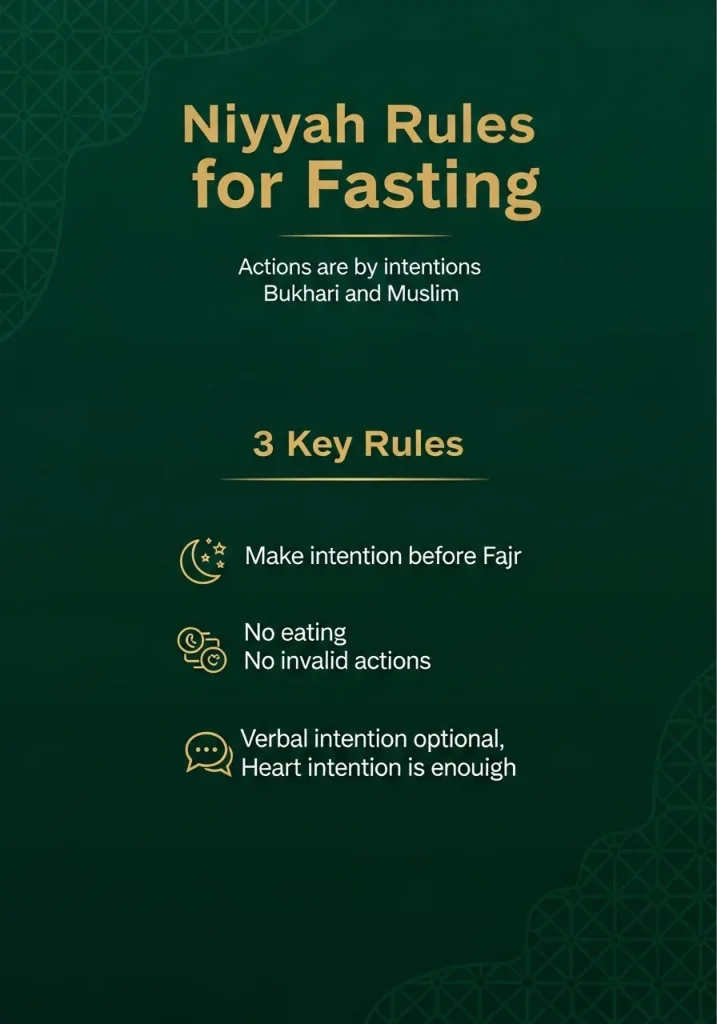
Niyyah means the intention in your heart. You don’t need words. The intention alone makes the fast valid.
But here’s what many Muslims don’t know: the fast requires Niyyah. Without it, the fast doesn’t count even if you ate nothing all day.
The Prophet ﷺ said:
“Actions are by intentions, and every person gets what they intend.” Bukhari & Muslim
Three key Niyyah rules:
بِصَوْمِ غَدٍ نَّوَيْتُ مِنْ شَهْرِ رَمَضَانَ
Bisawmi ghadin nawaytu min shahri Ramadan
“I intend to fast tomorrow for the month of Ramadan.”
Say it with your tongue. Hold it in your heart. Both together are best.
Suhoor: The Pre-Dawn Meal
Suhoor is the pre-dawn meal before Fajr. The Prophet ﷺ called it blessed:
“Eat Suhoor, for in Suhoor there is blessing.” Bukhari & Muslim
Eating Suhoor is a Sunnah, not a fasting condition. But skipping it regularly means missing a recommended act of worship.
The best time for Suhoor is as close to Fajr as possible. Eating anytime after midnight counts. But eating right before the Fajr adhan carries the most reward.
One important point: if the muezzin calls the adhan before true Fajr, eating is still permissible. Stop only when the true dawn (Fajr Sadiq) begins.
Iftar: Breaking the Fast at Sunset
Break the fast immediately at Maghrib. The Prophet ﷺ said:
“People will remain on good as long as they hasten to break the fast.” Bukhari
Delaying Iftar after confirmed sunset is Makrooh (disliked). However, on a cloudy day when sunset is uncertain, waiting two to three minutes is wiser and safer.
Break your fast with dates. This follows the Sunnah directly. If dates aren’t available, water works. Then pray Maghrib, and follow with a full meal.
Two Duas for Iftar:
At the moment of breaking fast:
اَللّٰهُمَّ لَكَ صُمْتُ وَعَلٰى رِزْقِكَ اَفْطَرْتُ
Allahumma laka sumtu wa ‘ala rizqika aftartu
“O Allah, for You I fasted and with Your provision I break my fast.”
After breaking fast:
ذَهَبَ الظَّمَأُ وَابْتَلَّتِ الْعُرُوْقُ وَثَبَتَ الأَجْرُ إِنْ شَاءَ اللّٰه
Dhahaba al-zama’u wabtallatil ‘urooqu wa thabatal ajru insha’Allah
“The thirst is gone, the veins are moistened, and the reward is confirmed, if Allah wills.” Abu Dawud
The Fast Is More Than Food and Drink
Many Muslims guard their stomachs but forget their tongues. The Prophet ﷺ warned:
“Whoever does not give up false speech and acting upon it, Allah has no need of him giving up his food and drink.” Bukhari
Ramadan fasting rules cover your entire character, not just what you consume. Guard your tongue from lying and backbiting. Control your anger. Give more in charity. Increase your Quran recitation.
The goal of every rule is Taqwa, God-consciousness. That’s what Allah asked for in Surah Al-Baqarah 2:183. Every rule protects that goal.
Here’s Section 3, the most detailed breakdown of this topic on the internet.
What Breaks Your Fast in Ramadan?
Most articles give you a basic list. This section gives you the full picture, scholar-backed, precise, and complete.
Scholars divide fast-breakers into two categories. Some require only Qada, making up the missed fast later. One category requires both Qada and Kaffarah, a serious expiation on top.
Know the difference. It matters.
Category One: Breaks the Fast Qada Only (No Kaffarah)
These nine situations invalidate your fast. But they only require making up the day later. No additional penalty applies.
1. Putting Medicine in the Ear or Nose
Inserting drops or medication into the ear or nose breaks the fast. The ruling applies even if you don’t taste anything. The passage connects to internal body cavities; that’s enough.
This ruling appears in classical Hanafi fiqh. Almost no English resource covers it. Now you know.
2. Intentionally Vomiting a Mouthful
Small involuntary vomiting doesn’t break the fast. But deliberately forcing out a full mouthful does. The keyword is intentionally. The Prophet ﷺ said:
“Whoever is overcome by vomiting is not required to make up the fast, but whoever vomits deliberately must make it up.” Abu Dawud, Tirmidhi
3. Water Going Down the Throat While Gargling
Gargling is fine. But if water accidentally slips down your throat during gargling, your fast breaks. Be careful during wudu. Rinse gently and don’t overfill your mouth.
This is one of the most common ways people unknowingly invalidate their fast.
4. Ejaculation Caused by Touching Without Intercourse
Physical contact with one’s spouse that leads to ejaculation breaks the fast. Intercourse didn’t occur, but the outcome did. Qada becomes necessary. This ruling comes directly from classical Hanafi fiqh texts.
5. Swallowing Something Inedible
Swallowing wood, iron, a raw grain, or anything humans don’t normally eat breaks the fast. The stomach received something, regardless of nutritional value. This surprises many people. The ruling is clear.
6. Intentionally Inhaling Smoke
Deliberately drawing smoke into your nose or throat breaks your fast. This includes:
- Cigarettes
- Hookah (shisha)
- Vaping
- Incense smoke is inhaled on purpose
The ruling applies to intentional inhalation only. Walking past smoke or accidentally breathing it in does not break the fast.
7. Forgetting You’re Fasting Then Eating Again on Purpose
This one is subtle. You forget you’re fasting and eat something. The Prophet ﷺ said that a person’s fast remains valid. But then you think the fast is already broken and eat again deliberately. That second act breaks the fast. Ignorance of the ruling doesn’t protect you here.
The Prophet ﷺ said:
“Whoever forgets while fasting and eats or drinks, let him complete his fast. Allah fed him and gave him drink.” Bukhari & Muslim
The key: once you remember, stop. Eating again on purpose after that that’s the violation.
8. Eating Suhoor After Fajr, Thinking It Was Still Night
You wake up, eat Suhoor, and then discover Fajr already begun. Your fast for that day is broken. Make it up after Ramadan. This is a common mistake, especially for those who rely on older timetables or ignore Fajr alerts.
9. Breaking Fast Early Thinking Sunset Already Came
You look outside, assume the sun has set, and break your fast. But it hadn’t. The fast is invalid. Qada is required. On cloudy days, wait 2-3 minutes to be safe. Don’t guess.
Category Two: Breaks the Fast Qada AND Kaffarah Required
One situation carries the heaviest consequence. If a person intentionally eats, drinks, or engages in marital relations during fasting hours, fully aware, not forgetful, Kaffarah becomes obligatory.
Kaffarah has three levels. You must follow them in order:
Level 1: Free an enslaved person. In today’s world, this option no longer exists practically.
Level 2: Fast 60 consecutive days without a single gap. Miss even one day without a valid excuse, and you restart from day one. All 60 days must connect.
Level 3: Feed 60 poor people two full meals each, to their fill. This applies only if someone genuinely cannot fast for 60 consecutive days.
This ruling comes from the Quran and is confirmed in both Bukhari and Muslim through the hadith of the man who broke his fast and came to the Prophet ﷺ seeking guidance.
Acts That Don’t Break the Fast But Are Disliked (Makrooh)
No competitor covers this. Yet every serious Muslim needs to know it.
Some acts don’t invalidate your fast, but they reduce its quality and reward. Scholars call these Makrooh (disliked). Avoid them.
1. Unnecessary Chewing or Tasting Food
Chewing gum, tasting salt, or testing food flavor, then spitting it out, these are all Makrooh. Nothing entered the body. But you flirted with eating. It diminishes the spirit of the fast.
2. Using Toothpaste, Tooth Powder, or Charcoal
Brushing with toothpaste during the fast is Makrooh, even if you don’t swallow. The strong flavor and particles create doubt. Use miswak instead. It cleans effectively and carries no such concern.
3. Spending the Entire Day in Janabah Without Ghusl
If you wake up in a state of major ritual impurity (janabah), your fast is still valid. But staying in that state all day without performing ghusl is Makrooh. Do ghusl as soon as possible.
4. Donating or Drawing Blood
Giving blood for medical purposes doesn’t break the fast. But it is Makrooh, especially if it causes weakness. If a medical professional needs your blood, the fast remains valid.
5. Backbiting (Gheebat)
Backbiting is haram at any time. During Ramadan, the sin multiplies. You guard your stomach from food but feed your tongue with someone’s honor. The Prophet ﷺ warned:
“Whoever does not give up false speech and acting upon it, Allah has no need of him giving up his food and drink.” Bukhari
6. Fighting, Arguing, or Using Foul Language
Quarreling during your fast makes it Makrooh. This includes cursing whether at a person, an animal, or even an object. If someone provokes you, the Prophet ﷺ taught a simple response:
“I am fasting, I am fasting.” Bukhari & Muslim
Say it. Mean it. Walk away.
Acts That Don’t Break the Fast And Aren’t Makrooh Either
These are fully permissible during fasting. Many Muslims avoid them unnecessarily out of caution, which has no basis.
| Act | Ruling |
| Using miswak | ✅ Fully permissible Sunnah |
| Applying oil to hair or a mustache | ✅ Permissible |
| Eye drops or kohl (surma) | ✅ Permissible even if the taste reaches the throat |
| Smelling perfume or attar | ✅ Permissible |
| Bathing due to heat or thirst | ✅ Permissible swallowing water is the issue, not bathing |
| Injections or vaccines | ✅ Permissible non-nutritional |
| Eating by mistake (forgetfulness) | ✅ Fast remains valid continue |
| Water unintentionally entering throat | ✅ Fast remains valid if truly unintentional |
| Involuntary vomiting | ✅ Does not break the fast |
| Nocturnal emission (wet dream) | ✅ Fast is valid perform ghusl and continue |
| Gum bleeding that doesn’t reach the throat | ✅ No issue unique Hanafi ruling |
| Waking up in janabah before Fajr | ✅ Fast is valid to make ghusl before prayer |
A note on eye drops and kohl: Some Muslims avoid surma during Ramadan entirely. The stronger scholarly position in the Hanafi school allows it, even if a slight taste reaches the throat, it doesn’t break the fast. Use it with confidence.
Who Is Exempt from Fasting in Ramadan?
Islam is a religion of mercy. Allah never intended fasting to cause genuine harm. He says:
“Allah intends for you ease and does not intend for you hardship.” Surah Al-Baqarah 2:185
This same Surah concludes with two powerful verses that emphasize Allah’s mercy, accountability, and compassion toward believers. You can explore their meaning and spiritual significance in our detailed guide on Surah Baqarah Last Two Ayats
But exemptions come with rules. Knowing those rules protects you from either unnecessary suffering or unwarranted negligence.
1. The Sick Person
Illness is the most common exemption. But not every sickness qualifies.
Two conditions allow a sick person to break or skip the fast:
- The illness makes fasting genuinely unbearable
- Fasting will worsen the condition significantly
A minor headache or mild fatigue doesn’t qualify. But if a qualified, trustworthy Muslim doctor confirms that fasting poses a real threat to health, breaking the fast isn’t just allowed. It becomes obligatory (Wajib).
Allah doesn’t want your worship to destroy you. Make up the missed days after recovery.
2. The Traveler Detailed Ruling
Travel is the most misunderstood exemption. Islam gives precise conditions — not vague permission.
Who qualifies as a Shar’i traveler?
A person who leaves home with the intention to travel at least 48 miles (approximately 77km). This distance comes from classical Hanafi fiqh and defines what scholars call Safar Shari, a legally qualifying journey.
Driving 20 minutes to the next town doesn’t count. A flight, a long road trip, or a journey to another city, these qualify.
Once you qualify, here’s what the ruling actually says:
The exemption exists, but it isn’t always the better choice.
- Travel causes you no hardship → fasting during travel is better (Afzal)
- Travel causes genuine hardship to you or your companions → not fasting is better
The Prophet ﷺ fasted during some journeys and broke his fast during others. He chose based on circumstances, not habit.
Three specific travel scenarios scholars address:
Scenario 1: You start the day fasting, then begin your journey. You must complete that day’s fast. The day started at home, under normal conditions. Finish it.
Scenario 2: You’re traveling and return home mid-day. You haven’t eaten anything yet. It’s still 1.5 hours before Dhuhr. Make the intention right then — and fast the rest of the day. The option remains open to you.
Scenario 3: You return home mid-day but have already eaten during travel. Don’t eat or drink for the rest of the day out of respect for Ramadan. Make up the full day later.
3. Pregnant Women
A pregnant woman may skip fasting if she genuinely fears harm — either to herself or to her unborn child. The fear must be real and reasonable, not just discomfort.
If she skips fasting, she makes up the missed days after delivery and recovery. Allah’s mercy covers both mother and child.
4. Breastfeeding Mothers
A nursing mother follows the same principle. If fasting causes her milk to reduce significantly and that harms her baby, she may break her fast. Make up those days later.
This applies whether she nurses her own child or another’s.
5. The Elderly
An elderly person who physically cannot fast and whose condition won’t improve falls under a permanent exemption. They don’t make up the days. Instead, they pay Fidya for each missed fast.
Fidya means feeding one poor person a full day’s meals for every day missed. This compensates for the obligation they can no longer physically fulfill.
6. Women During Menstruation and Postnatal Bleeding
Women in a state of Haid (menstruation) or Nifas (postnatal bleeding) cannot fast. Fasting during these days is not permitted, but merely discouraged.
Once these days pass, they make up for every missed fast before the next Ramadan arrives.
This ruling carries no shame. It reflects Islam’s practical wisdom and deep respect for women’s physiology.
7. Children
Fasting is not obligatory before puberty. But gradually introducing children to fasting builds lifelong habits.
Start with half-day fasts. Then full days on weekends. Praise effort, not perfection. The Prophet ﷺ encouraged this gradual approach with the children of the Ansar.
The Coercion Ruling: What No Competitor Tells You
This ruling exists in classical fiqh. Yet virtually no English Islamic content covers it.
If someone threatens you with death to force you to break your fast, you may break it. Your life has value in Islam. Preserving it takes priority.
“Whoever is forced under compulsion, Allah is Forgiving, Merciful.” Surah Al-Baqarah 2:173 (principle applied by scholars to coercion)
Make up the day after Ramadan. No Kaffarah applies. The sin lies entirely with whoever coerced you.
A Reminder for Those Who Are Exempt
Islam exempts you. But it still asks you to show respect for the month.
Those exempt from fasting, the sick, the traveler, the menstruating woman, should not eat or drink openly in front of others who are fasting. Ramadan deserves honor, even from those who cannot participate fully.
The Prophet ﷺ built a community where everyone protected the sanctity of this month regardless of their personal condition.
Who Must Make Up Missed Fasts (Qada)?
| Category | Make Up Later? | Pay Fidya? |
| Sick (temporary) | ✅ Yes | ❌ No |
| Traveler | ✅ Yes | ❌ No |
| Pregnant woman | ✅ Yes | ❌ No |
| Breastfeeding mother | ✅ Yes | ❌ No |
| Menstruation / Nifas | ✅ Yes | ❌ No |
| Elderly (permanent) | ❌ No | ✅ Yes |
| Chronic illness (permanent) | ❌ No | ✅ Yes |
| Coercion | ✅ Yes | ❌ No |
Here’s Section 5, clean, precise, and more detailed than anything competitors have published.
Missed a Fast? Here’s Exactly What to Do
Life happens. Illness strikes. Travel begins. Women experience their monthly cycle. Islam anticipated all of it.
Missing a fast doesn’t mean losing Ramadan. It means you have a debt, and Islam tells you exactly how to repay it.
There are three types of obligation depending on your situation: Qada, Fidya, and Kaffarah. Each has different conditions, different rules, and different consequences for delay.
Qada Making Up Missed Fasts
Qada means fasting a missed day at a later time. It applies to everyone who missed fasts due to a temporary, valid excuse, such as illness, travel, pregnancy, menstruation, or postnatal bleeding.
The golden rule: don’t delay.
As soon as your excuse ends, you recover, you return home, your cycle is finished, and you start making up those days. Life is unpredictable. Health is not guaranteed. The Prophet ﷺ taught us:
“Take advantage of five before five: your youth before old age, your health before illness, your wealth before poverty, your free time before being busy, and your life before death.” Hakim (Sahih)
That wisdom applies directly here. Make up your fasts while you can.
Can you make them up one by one or all at once?
Both are valid. Islam gives you full flexibility here.
Fast them consecutively one after another if that works for your schedule. Or spread them out, one or two at a time, across the months between Ramadans. Either approach fulfills your obligation.
What matters is that you complete them before the next Ramadan arrives.
What if the next Ramadan arrives before you finish?
Fast the current Ramadan first. Then make up the remaining missed days afterward.
Scholars differ on whether a person who delays without a valid excuse must pay Fidya on top of Qada. The stricter position says yes, one Fidya payment per day delayed past the following Ramadan. Take this seriously. Don’t let missed fasts accumulate year after year.
What if you ran out of time through no fault of your own?
This is the mercy ruling most people never hear about.
A traveler returns home late in the year. A sick person recovers just weeks before the next Ramadan. They genuinely didn’t have enough time to make up all their missed days.
In this case, they only owe what time is allowed.
If you had 30 days to make up and only recovered with 15 days remaining before Ramadan, you owe 15 days of Qada. The remaining 15 days fall away. Allah doesn’t burden a soul beyond its capacity:
“Allah does not burden a soul beyond that it can bear.” Surah Al-Baqarah 2:286
Fidya Compensation for Permanent Inability
Fidya is a charitable payment. It applies to those who cannot fast now and have no realistic hope of fasting later.
This covers:
- The elderly who are too frail to fast
- Those with chronic, permanent illness
- Anyone whose condition will not improve
How much is Fidya?
For each missed fast, feed one poor person two full meals enough to satisfy them completely. This must cover every single missed day of Ramadan.
Fidya cannot substitute for Qada in temporary situations. A sick person who expects to recover must fast and not pay Fidya. Fidya is only for those with no path back to fasting.
Kaffarah Expiation for Deliberate Breaking
Kaffarah is the heaviest obligation in this section. It applies in one specific situation only:
A person deliberately eats, drinks, or engages in marital relations during Ramadan fasting hours, fully aware, with no forgetfulness, no coercion, and no valid excuse.
This isn’t a simple mistake. This is a conscious choice to violate an act of worship. The consequence reflects that gravity.
Kaffarah has three levels. Follow them in strict order:
Level 1: Free an enslaved person.
This was the primary expiation in the time of the Prophet ﷺ. Today, lawful slavery no longer exists. This option is practically unavailable. Move to Level 2.
Level 2: Fast 60 consecutive days.
Sixty days. No gaps. No exceptions except unavoidable ones like illness or menstruation, which scholars permit as interruptions that don’t restart the count.
But deliberate skipping of even one day restarts the count from day one. All 60 days must connect. This is not easy. It isn’t meant to be.
The Prophet ﷺ confirmed this obligation when a man came to him and said he had destroyed himself by having relations with his wife during Ramadan. The Prophet ﷺ responded by walking him through exactly these three levels. Bukhari & Muslim
Level 3: Feed 60 poor people two full meals each.
If someone genuinely cannot fast for 60 consecutive days due to age, chronic illness, or medical inability, they feed 60 people. Each person must receive two satisfying meals for that day.
This is the final option. It isn’t a shortcut for those who find 60 days inconvenient.
One Kaffarah per Ramadan, not per incident.
If a person intentionally breaks their fast multiple times in the same Ramadan, one Kaffarah covers all violations as long as they hadn’t already completed a Kaffarah in between. This comes from the Hanafi position based on the hadith narrated in Bukhari and Muslim.
Quick Reference Qada, Fidya, and Kaffarah
| Situation | Qada Required | Fidya Required | Kaffarah Required |
| Illness (temporary) | ✅ Yes | ❌ No | ❌ No |
| Travel | ✅ Yes | ❌ No | ❌ No |
| Pregnancy / Breastfeeding | ✅ Yes | ❌ No | ❌ No |
| Menstruation / Nifas | ✅ Yes | ❌ No | ❌ No |
| Elderly / Permanent illness | ❌ No | ✅ Yes | ❌ No |
| Coercion | ✅ Yes | ❌ No | ❌ No |
| Deliberate eating/drinking | ✅ Yes | ❌ No | ✅ Yes |
| Deliberate marital relations | ✅ Yes | ❌ No | ✅ Yes |
| Accidental/forgetful eating | ❌ No | ❌ No | ❌ No |
Here’s Section 6 spiritual depth your competitors simply don’t reach.
The Spiritual Rules of Ramadan Beyond Food and Drink
Most people treat Ramadan as a diet with prayer. It isn’t.
Fasting without spiritual discipline is an incomplete act of worship. The Prophet ﷺ made this unmistakably clear:
“Many a fasting person gains nothing from their fast except hunger and thirst.” Ibn Majah, Darimi
Allah didn’t prescribe Ramadan to empty your stomach. He prescribed it to build Taqwa, genuine God-consciousness that reshapes your character from the inside.
The physical rules protect the fast. The spiritual rules protect their purpose.
Guard Your Tongue
Your tongue can destroy a fast that your stomach protected all day.
Lying, backbiting, and spreading rumors don’t invalidate the fast technically. But they strip away its reward. The Prophet ﷺ warned:
“Whoever does not give up false speech and acting upon it, Allah has no need of him giving up his food and drink.” Bukhari
During Ramadan, treat your tongue like your stomach. Feed neither with what harms you.
Control Your Anger
Hunger makes people irritable. Ramadan asks you to rise above that.
When someone provokes you at home, at work, or on the road, the Prophet ﷺ gave you a specific response:
“If someone fights you or insults you, say: I am fasting, I am fasting.” Bukhari & Muslim
Say it out loud. It reminds you. It disarms them. It protects your fast’s reward.
Anger management isn’t a modern concept. The Prophet ﷺ built it into Ramadan 1,400 years ago.
Give Generously
Ramadan multiplies the reward of every good deed. The Prophet ﷺ was the most generous person alive, and his generosity peaked in Ramadan.
Ibn Abbas said:
“The Prophet ﷺ was the most generous of people, and he was most generous in Ramadan.” Bukhari
Give Sadaqah daily, even something small. Feed a fasting person. Support a neighbor in need. Every act of giving in Ramadan carries extraordinary weight.
Recite and Reflect on the Quran
Ramadan and the Quran share a bond unlike any other month. Allah revealed the Quran in Ramadan. Jibreel reviewed it with the Prophet ﷺ every Ramadan night.
“The month of Ramadan is the one in which the Quran was revealed.” Surah Al-Baqarah 2:185
Don’t just recite, reflect. Read the translation. Understand what you recite. Even 5 verses a day with reflection outweighs 50 verses read without thought.
If you want to complete the Quran this Ramadan, read 4 pages after each of the 5 daily prayers. That brings you to 20 pages a day, one full Juz. Thirty days, thirty Juz. Done.
Pray Taraweeh And Pray It Correctly
Taraweeh is one of the greatest acts of worship in Ramadan. Yet most Muslims don’t know its full ruling or its conditions.
Here is the complete picture.
What is Taraweeh?
Taraweeh consists of 20 rakats prayed after the Fard and Sunnah of Isha. It carries the status of Sunnah Mu’akkadah a confirmed Sunnah that the Prophet ﷺ established and encouraged consistently.
Umar ibn al-Khattab (RA) formalized the congregational form. The Ummah has observed it ever since.
Praying in Congregation: A Community Obligation
Taraweeh in congregation holds the status of Sunnah Kifa’iyyah, a collective community obligation.
This means: if at least one person in a neighborhood prays Taraweeh in the local mosque, the obligation lifts from everyone else. They may pray at home and still fulfill the Sunnah.
But if nobody in the entire neighborhood prays Taraweeh in congregation, every single resident shares in the sin of abandoning it.
This ruling comes directly from classical Hanafi fiqh. Most English-language articles never mention it.
Completing the Quran in Taraweeh
Finishing the entire Quran during Taraweeh is also a Sunnah. Scholars consistently recommend it. Communities that achieve this honor both the prayer and the month together.
The Sin of Rushed Recitation
This is where many mosques fail and where you need to protect yourself as a worshipper.
Rushing through recitation so fast that letters merge, rules of Tajweed are broken, and words become unrecognizable is a major sin. The Prophet ﷺ warned against reciting the Quran carelessly.
The ruling is severe: neither the imam nor the followers receive reward for a Taraweeh prayed with clipped, distorted recitation.
If your local mosque rushes through 20 rakats in 20 minutes with broken Arabic prayers behind them for the congregation’s sake, then repeat your recitation at home. Your worship deserves better than speed.
Paying a Hafiz to Lead Taraweeh: The Ruling
Many mosques collect funds to hire a Hafiz for Ramadan. Most communities accept this without question.
The classical Hanafi ruling is clear: paying a Hafiz a fee to lead Taraweeh is impermissible (haram). Taking payment for reciting the Quran in prayer falls under prohibited compensation for an act of worship.
If your community cannot find a Hafiz willing to lead without payment, don’t hire one. Instead, pray Taraweeh with short surahs. Al-Ikhlas, Al-Falaq, An-Nas. Simple, valid, and rewarded.
The integrity of the worship matters more than its appearance.
Pray the Night Prayer Qiyam al-Layl
Beyond Taraweeh, Ramadan nights carry exceptional reward for voluntary prayer.
The Prophet ﷺ said:
“Whoever prays at night in Ramadan out of faith and seeking reward, his previous sins will be forgiven.” Bukhari & Muslim
Even two rakats of Tahajjud after midnight, prayed with focus and sincerity, can outweigh hours of distracted worship earlier in the night.
Increase Dua Especially at Iftar
Two moments in every Ramadan day carry special power for Dua:
Just before Iftar, the fasting person’s supplication is accepted. The Prophet ﷺ said:
“Three supplications are not rejected: the supplication of the fasting person when breaking fast, the just ruler, and the oppressed.” Tirmidhi (Hasan)
The last third of the night, Allah descends to the lowest heaven and asks: “Who is calling on Me that I may answer? Who is seeking from Me that I may give?” Bukhari & Muslim
These two windows repeat every single day of Ramadan. Use them.
Ramadan Is a Full Transformation Not a Partial One
Guard your eyes. Guard your ears. Guard your thoughts.
What you consume through screens, conversations, and entertainment shapes your heart just as surely as food shapes your body. Ramadan asks you to audit everything, not just your meals.
The Prophet ﷺ completed full reviews of the Quran with Jibreel. He intensified his worship. He reduced his sleep. He increased his giving.
That is the model. Food and drink are just the entry point.
Here’s Section 7, written to honor the weight of this topic.
Laylatul Qadr: The Night Worth More Than a Lifetime
Previous nations lived for centuries. They had hundreds of years to accumulate worship and earn reward.
This Ummah lives shorter lives. Sixty, seventy, eighty years if we’re fortunate.
Allah saw this gap. In His mercy, He gave us something that no previous nation received in the same form. He gave us Laylatul Qadr one night whose worship outweighs 83 years of continuous devotion.
He declared it in the Quran:
“The Night of Decree is better than a thousand months.” Surah Al-Qadr 97:3
A thousand months is 83 years and 4 months. Most people never live that long. Yet this single night available every Ramadan hands you that reward.
Missing it isn’t just unfortunate. Our scholars call it what it is: a great deprivation.
When Is Laylatul Qadr?
Allah concealed the exact date. This wasn’t an oversight; it was intentional. He wants you to search for it. He wants you to fill multiple nights with worship, not just one.
The Prophet ﷺ said:
“Seek Laylatul Qadr in the odd nights of the last ten days of Ramadan.” Bukhari & Muslim
The odd nights are the 21st, 23rd, 25th, 27th, and 29th.
Among these, the 27th night carries the strongest probability. Ubayy ibn Ka’b (RA), one of the greatest companions, swore by Allah that it falls on the 27th. Many scholars across generations have agreed.
But don’t gamble on one night. Treat all five as if each one is the night.
What Happens on This Night?
Allah describes it:
“The angels and the Spirit descend therein by permission of their Lord for every matter. Peace it is until the emergence of dawn.” Surah Al-Qadr 97:4-5
Jibreel (AS) descends with armies of angels. They spread across the earth. They say Salam upon every worshipper engaged in prayer, Quran, or Dhikr until Fajr arrives.
Ibn Abbas (RA) reported that the Prophet ﷺ said this night holds peace and safety from every harm, until the break of dawn. Ibn Khuzaymah
The night doesn’t announce itself with lights in the sky or extraordinary signs visible to all. It arrives quietly. Only those who have prepared and who show up receive it.
The Dua of Laylatul Qadr
Aisha (RA) asked the Prophet ﷺ: “If I know which night is Laylatul Qadr, what should I say?”
He replied:
اَللّٰهُمَّ اِنَّكَ عَفُوٌّ تُحِبُّ الْعَفْوَ فَاعْفُ عَنِّي
Allahumma innaka ‘afuwwun tuhibbul ‘afwa fa’fu ‘anni
“O Allah, You are the Pardoner. You love to pardon. So pardon me.” Tirmidhi (Sahih)
This is the most important Dua of the year. Memorize it. Repeat it throughout each of the last ten nights. Ask for pardon, not just reward.
The Last Ten Nights: How the Prophet ﷺ Spent Them
The Prophet ﷺ didn’t treat these nights casually.
Aisha (RA) said:
“When the last ten nights of Ramadan began, the Prophet ﷺ would tighten his waist-wrapper, spend his nights in worship, and wake his family.” Bukhari & Muslim
He intensified everything. Less sleep. More prayer. More Quran. More Dua. He woke his wives. He brought his entire household into these nights.
That is the standard. That is the model.
The Scholarly Warning: Don’t Waste These Nights
Our classical scholars issued a direct warning about how people misuse the last ten nights.
Spending these sacred evenings in lectures, talks, gatherings, and social events, then going home to sleep, is a great deprivation. The scholars used strong language intentionally.
Lectures have their place. Every other night of Ramadan welcomes them. But on the odd nights of the last ten, the night belongs to personal worship between you and Allah.
Attend a short reminder if needed. Then pray. Then recite. Then make Dua. Then pray more. The night is long. Use it.
What If You Can’t Stay Up All Night?
Not everyone can. Work continues. Children need care. Health has limits.
Allah’s mercy reaches here too.
The Prophet ﷺ said:
“Whoever prays Isha in congregation has taken his share of Laylatul Qadr.”
And in another narration:
“Whoever prays Isha and Fajr in congregation — it is as if he spent the entire night in worship.” Muslim
This is not a concession for the lazy. It is a mercy for the genuinely unable.
If exhaustion overtakes you, pray Isha in the mosque. Sleep. Wake before Fajr. Make Wudu. Pray Fajr in congregation. You have claimed the night’s reward through the mercy of your Lord.
But if you have the energy, give everything you have. These five nights come once a year. The rest of the year belongs to regular life.
A Night-by-Night Worship Plan for the Last Ten
If you can stay up partially or fully:
| Time | Worship |
| After Isha + Taraweeh | Quran recitation, even 1 Juz with reflection |
| Middle of the night | Tahajjud minimum 2 rakats, maximum as many as you can |
| Throughout the night | Repeat Laylatul Qadr Dua continuously |
| Before Fajr | Suhoor + sincere personal Dua for your list, your needs, your family |
| Fajr | Pray in congregation, seal the night |
If you cannot stay up:
- Pray, Isha, in congregation
- Sleep with the intention of worship
- Wake 15 minutes before Fajr
- Make Wudu, pray 2 rakats Tahajjud, make Dua
- Pray Fajr in congregation
Even this minimum, done with sincerity on the right night, can change the trajectory of your entire year.
One Final Reminder
Laylatul Qadr doesn’t reward performance. It rewards sincerity.
You don’t need a beautiful voice. You don’t need to finish the entire Quran that night. You don’t need to stand until your feet crack.
You need to show up with a clean heart, a genuine need, and full belief that Allah hears every word.
The Prophet ﷺ said:
“Whoever spends Laylatul Qadr in prayer out of faith and seeking reward his previous sins will be forgiven.” Bukhari & Muslim
Previous sins. Forgiven. That is what one night can do.
Don’t miss it.
Itikaf in Ramadan: Rules, Conditions, and How to Observe It
Most Muslims know Itikaf exists. Few know how it actually works.
This section gives you the complete ruling straight from classical Hanafi fiqh. No vagueness. No shortcuts.
What Is Itikaf?
Itikaf means seclusion in the mosque with the intention of worship. You enter. You stay. You direct your entire being toward Allah, away from the noise of daily life.
It isn’t isolation for its own sake. It is deliberate, intentional proximity to Allah during the most powerful nights of the year.
The Prophet ﷺ observed Itikaf every Ramadan without exception. In the year he passed away, he observed it for twenty days instead of ten. Abu Dawud
What Is Its Status?
Itikaf in the last ten nights of Ramadan carries the status of Sunnah Mu’akkadah Kifa’iyyah, a confirmed collective community obligation.
Understand what this means practically:
- If at least one person in a neighborhood observes Itikaf in the local mosque, the obligation lifts from everyone else in that community.
- If nobody in the entire neighborhood observes it, every resident shares in the sin of abandoning an established Sunnah of the Prophet ﷺ.
This isn’t a minor point. The Prophet ﷺ never abandoned Itikaf during his lifetime. Our communities shouldn’t abandon it either.
When Does Itikaf Begin and End?
Entry: Before sunset on the 20th of Ramadan. Enter the mosque and make your intention before the sun goes down. The last ten nights begin with the sunset of the 20th day — so your Itikaf must start there.
Exit: When the Eid moon is sighted. Once Ramadan ends and Eid is confirmed, Itikaf concludes. You leave the mosque and join your community for Eid.
Don’t enter late. Don’t leave early. The timing is precise for a reason.
What Can You Leave the Mosque For?
This is where many people make mistakes — either too strict or too relaxed.
You may leave the mosque only for genuine, unavoidable needs that cannot be fulfilled inside:
✅ Using the toilet ✅ Performing obligatory Ghusl (major ritual bath) ✅ Making Wudu — if no facility exists inside the mosque
That’s it. Every other reason to leave invalidates the Itikaf.
You cannot leave for:
❌ Buying food or drinks — arrange delivery or have someone bring it ❌ Visiting family, even briefly ❌ Attending a funeral, even for a close relative — unless you made a prior condition ❌ Bathing for Jumu’ah or cooling down from heat — these don’t qualify ❌ Any errand, no matter how short
The Jumu’ah Ruling — A Detail Most People Miss
What if the mosque where you observe Itikaf doesn’t hold Jumu’ah prayer?
You must attend Jumu’ah, it remains obligatory. But you must manage your exit carefully.
Leave the mosque early enough to reach the Jumu’ah mosque, perform the Sunnah prayers before the Khutbah, and catch the Khutbah from its beginning.
Arriving late or spending extra time outside the mosque is permitted if genuinely unavoidable. Your Itikaf remains intact. But don’t use Jumu’ah as an excuse to wander.
What Invalidates Itikaf Immediately?
Leaving the mosque without necessity — even for one minute — invalidates Itikaf completely.
It doesn’t matter whether you left intentionally or forgot. Both break it. This ruling is strict and unambiguous in the Hanafi school.
If your Itikaf breaks, make it up. Observe a makeup Itikaf after Ramadan. The obligation doesn’t disappear because you made a mistake.
What Worship Should You Do Inside?
Here is what surprises most people: no specific worship is required during Itikaf. There is no mandatory schedule.
Pray. Recite the Quran. Study Islamic books. Make Dhikr. Make Dua. Sleep when needed. Eat when food arrives.
All of it counts. All of it is worship — because your presence in that mosque, with that intention, makes every moment an act of devotion.
The Prophet ﷺ didn’t prescribe a rigid Itikaf schedule. He left it open, so every person can worship according to their capacity and sincerity.
The Silence Misconception — Cleared Up
Many people believe Itikaf requires complete silence. Some treat unnecessary silence as extra piety.
The classical ruling is the opposite: unnecessary silence is Makrooh — disliked in Islam.
You may speak. You may teach. You may answer questions. You may have beneficial conversations with those who visit.
What you must avoid: idle talk, gossip, arguments, and anything that contradicts the spirit of worship. Silence for its own sake — with no religious basis — carries no extra reward.
Speak when speech benefits. Stay quiet when quiet serves worship. Let sincerity guide you — not performance.
Itikaf for Women
Women may observe Itikaf in a designated prayer area within their home, according to the Hanafi position. They do not need to go to the mosque.
The conditions remain the same: intention, staying within the designated space, and leaving only for unavoidable needs.
A woman’s Itikaf carries the same spiritual weight. The location differs, but the reward does not.
Why Itikaf Transforms the Last Ten Nights
Consider what Itikaf removes from your life for ten days:
- Screens and social media
- Work stress and deadlines
- Social obligations and small talk
- The constant pull of daily routine
And consider what it places you inside:
- The house of Allah
- The company of angels descending on Laylatul Qadr
- Uninterrupted hours of worship during the most valuable nights of the year
The Prophet ﷺ observed Itikaf to seek Laylatul Qadr. He found it. He returned every year.
“The Prophet ﷺ used to observe Itikaf in the last ten days of Ramadan until Allah took his soul.” — Bukhari & Muslim
If you have the ability — even one year — give these ten days entirely to Allah. Nothing in the calendar of a Muslim’s life compares to it.
Itikaf Quick Reference
| Rule | Detail |
| Status | Sunnah Mu’akkadah Kifa’iyyah |
| When to enter | Before sunset, 20th of Ramadan |
| When to exit | Upon sighting of Eid moon |
| Valid reasons to leave | Toilet, obligatory Ghusl, Wudu only |
| Silence required? | No — unnecessary silence is Makrooh |
| Leaving briefly without need | Invalidates Itikaf — make it up |
| Specific worship required? | No — any act of worship is valid |
| Women’s Itikaf | Designated space at home |
| Jumu’ah attendance | Required — leave only as needed |
Here’s Section 9B — precise, practical, and packed with rulings your competitors don’t touch.
Zakat and Zakat al-Fitr in Ramadan — What You Need to Know
Ramadan isn’t only about fasting. It carries two financial obligations that every eligible Muslim must fulfill.
Zakat — the annual purification of wealth — falls due regardless of the month. But most Muslims calculate and pay it during Ramadan, when every good deed carries a multiplied reward.
Zakat al-Fitr — the fast-breaking charity — is specific to Ramadan. It falls due before Eid prayer and purifies the fast itself.
Know both. Pay both correctly.
Zakat al-Fitr — The Charity of Ramadan’s End
Zakat al-Fitr is obligatory on every Muslim who possesses food beyond their basic needs on the day of Eid.
The Prophet ﷺ made it clear:
“The Messenger of Allah ﷺ made Zakat al-Fitr obligatory as a purification for the fasting person from idle talk and indecency, and as food for the poor.” — Abu Dawud, Ibn Majah
Two purposes. One payment.
Who must pay it?
Every Muslim — man, woman, child, elderly — who has surplus food on Eid day. A father pays on behalf of his dependents. If a child has their own wealth, they pay from that.
When must you pay it?
Pay it before the Eid prayer. This is the condition for it to count as Zakat al-Fitr. Paying after Eid prayer reduces it to ordinary Sadaqah — the specific obligation is missed.
Scholars recommend paying it in the last two or three days of Ramadan. Early payment ensures the poor receive it before Eid morning.
How much is it?
One Sa’ of staple food — wheat, dates, raisins, barley — per person. In contemporary practice, most scholars permit paying its monetary equivalent. Check your local scholar or Islamic organization for the current year’s amount in your currency.
Zakat — The Annual Obligation on Wealth
Zakat is the third pillar of Islam. Allah paired it with Salah repeatedly in the Quran:
“Establish prayer and give Zakat.” — Surah Al-Baqarah 2:43
This pairing isn’t coincidental. Prayer connects you to Allah. Zakat connects you to humanity. Both are non-negotiable.
The Nisab — Minimum Threshold for Zakat
Zakat only becomes obligatory when your wealth reaches the Nisab — the minimum qualifying threshold.
The Nisab is:
- 52.5 tolas of silver (approximately 612 grams)
- OR 7.5 tolas of gold (approximately 87.5 grams)
- OR their equivalent value in cash, trade goods, or other zakatable assets
The silver Nisab is the more commonly applied threshold today — and the more precautionary one, as it is lower in value. Check current silver prices to calculate your Nisab for this year.
One full lunar year (Hawl) must pass with your wealth at or above the Nisab. If your wealth drops below Nisab at any point during the year, the year resets.
The Rate — How Much Do You Pay?
2.5% of your total zakatable wealth.
That is one-fortieth of everything that qualifies. Not income. Not what you earned this year. Your total accumulated qualifying wealth that has sat above Nisab for a full lunar year.
What Does Zakat Apply To?
This is where most people have gaps in their knowledge.
Zakat applies to:
Gold and silver — in every form. Jewelry, coins, bars, decorative items. If it’s gold or silver, Zakat is obligatory on it. Wedding rings, bangles, gold embroidery on clothing — all of it qualifies.
Cash and bank deposits — treated exactly like silver and gold under Islamic law.
Trade goods — any inventory held for buying and selling. Calculate its current market value on your Zakat due date.
Company shares — a modern ruling that classical scholars have addressed directly. Shares in companies are subject to Zakat. However, since share prices include the value of machinery, real estate, and equipment (which are exempt), you may contact the company, determine what portion of the share price represents exempt assets, subtract that portion, and pay Zakat on the remainder. This adjustment is both permissible and precise.
Provident funds and pension savings — Zakat does not apply while the funds remain locked and inaccessible during employment. Once you receive the funds — upon retirement or resignation — Zakat becomes due on that amount. Pay for the current year only. Previous years don’t carry back.
What Zakat Does NOT Apply To?
Machinery and factory equipment — tools of production are exempt. The machines themselves carry no Zakat. But the goods they produce and the raw materials waiting to be processed — both are subject to Zakat.
Your home, car, and personal belongings — items for personal use carry no Zakat obligation.
Unpaid debts owed to you — if you have money owed to you that you genuinely cannot recover, you don’t pay Zakat on it until you receive it.
Can You Pay Zakat in Advance?
Yes. Paying Zakat before your annual due date is permissible.
If your Zakat normally falls due in Muharram but you want to pay it in Ramadan for the increased reward, you may. This is valid.
One condition: if your wealth increases further before your actual due date arrives, calculate the difference and pay Zakat on the additional amount separately.
The Makrooh Ruling on Large Single Payments
Here is a specific ruling that no English competitor mentions.
Giving one poor person a single payment equal to or exceeding the Nisab amount is Makrooh — disliked by scholars.
The reasoning: Islam distributes wealth broadly. Concentrating a large Zakat payment in one person’s hands in a single transaction contradicts that spirit — even though the Zakat technically counts as paid.
Spread your Zakat. Give multiple people meaningful amounts. If you must give one person a large sum, distribute it across separate occasions rather than one lump payment.
Who Receives Zakat?
Allah defined the eight categories of Zakat recipients in the Quran:
“Zakat is only for the poor, the needy, those employed to collect it, those whose hearts are to be reconciled, for freeing captives, for those in debt, for the cause of Allah, and for the stranded traveler.” — Surah At-Tawbah 9:60
Your Zakat must reach one of these eight categories. Paying it to ineligible recipients — wealthy relatives, mosques for construction, or institutions that don’t distribute to individuals — doesn’t fulfill the obligation.
Zakat and Ramadan — Why Muslims Pay Together
Ramadan doesn’t make Zakat obligatory. Your individual lunar year determines that.
But the Prophet ﷺ was most generous in Ramadan. The reward of every act multiplies. Muslims across the world align their Zakat payments with Ramadan deliberately — to combine financial worship with the month of maximum spiritual reward.
If your Zakat due date falls in Ramadan, pay it immediately. If it falls outside Ramadan, consider paying early to capture Ramadan’s blessing, as long as your Nisab condition is met.
Ibn Abbas (RA) said:
“The Prophet ﷺ was the most generous of people, and he was most generous in Ramadan when Jibreel met with him.” — Bukhari
Generosity in Ramadan isn’t optional extra credit. It reflects the character of the Prophet ﷺ himself.
Quick Reference — Zakat and Zakat al-Fitr
| Zakat al-Fitr | Zakat | |
| Obligation | Every Muslim with surplus food | Every Muslim above Nisab for one lunar year |
| Amount | One Sa’ of staple food or equivalent cash | 2.5% of total zakatable wealth |
| Deadline | Before Eid prayer | Annual lunar due date |
| Purpose | Purify the fast, feed the poor | Purify wealth, support the needy |
| Applies to children? | Yes — paid by guardian | Yes — from child’s own wealth if applicable |
| Advance payment? | Yes — last 2-3 days of Ramadan | Yes — permissible before due date |